

's Neuroleadership and the Power of AI. Become a leader of the new era.
Leadership in an era of geopolitical uncertainty, AI, and constant change requires more than just intuition and experience. It requires an understanding of how your brain works—and how to make AI work for you, not against you.





Today's world needs a new kind of leader.
Armed conflicts on Europe’s doorstep, the breakdown of global supply chains, inflationary pressures, and the technological race among major powers—today’s leaders are facing ever-increasing market uncertainty.
In a world of transformative change and decision-making pressures, leaders can no longer rely solely on intuition and experience. They must understand how the human brain works—their own and that of their employees—and how to effectively use artificial intelligence tools that are redefining the way we think, learn, and lead.
Neurobiology and AI as the foundations of modern leadership. Leadership of the future.
The ICAN Future Ready Leadership Academy™ is a next-generation leadership development program that combines the best of NeuroLeadership with the groundbreaking concept of AI-Augmented Leadership.

Management Based on Brain Science
Understanding how the minds of a leader and their team work is the foundation of effective leadership in a world of complexity and pressure.
- How the brain responds to stress, uncertainty, and change
- How to Create an Environment That Fosters Motivation and Engagement
- How to make decisions in line with the biology of thinking—your own and your team’s
A revolutionary approach to leadership
Leaders need to understand the potential of AI and make use of it. In this program, we teach:
- how AI supports decision-making through data analysis,
- how to use AI to foster empathy, self-awareness, and values-based leadership,
- How to build your own leadership model supported by AI—as an ally.
Future Ready Leadership is a fusion of two worlds: neurobiology and technology. A leader understands the mechanisms of human behavior and knows how to harness the power of algorithms.
Understanding, how the brain the brain and how AI can support our perception, reflection and self-awareness, is today is luxury – it a necessity.
Space is limited
Who will benefit most from participating in the program?
The program is designed for experienced senior managers who wish to elevate their leadership skills in an environment marked by geopolitical and market uncertainty, intense pressure, and constant change driven, among other factors, by the advancement of AI.
CEOs, vice presidents, board members, directors
Senior leaders responsible for the organization's strategic direction.
Change management managers
Individuals responsible for transformation, strategy, and organizational culture.
HR Business Partners
People who want to create efficient and modern work environments.
Leaders of transformation teams
People who want to hone their leadership skills in a world shaped by AI and change.
Make sure this program is right for you
We offer two neuroscience-related development programs. See which one best suits your needs and challenges.
|
|

|
|
|---|---|---|
|
For whom
|
CEOs, business owners, board members, and directors (C-level executives). | Managers with 1–5 years of experience who work in demanding and stressful environments. |
|
Program objective
|
Transforming leadership at the leader–team–organization level through the integration of neuroscience and AI. | Increasing effectiveness in situations of pressure, conflict, and uncertainty. |
|
Common challenges
|
The complexity and unpredictability of the environment, the need to combine data with intuition, and the use of AI without losing the "human touch." | Difficult conversations, team tensions, decisions under pressure, dealing with change and crises. |
|
What does it teach?
|
Neuroleadership, the integration of data, intuition, and emotions, change and transformation management, and AI in management. | Resolve conflicts, work under stress, develop your own and your team's resilience, make good decisions under pressure. |
|
Format
|
10 two-day in-person sessions. | 5 two-day on-site sessions. |
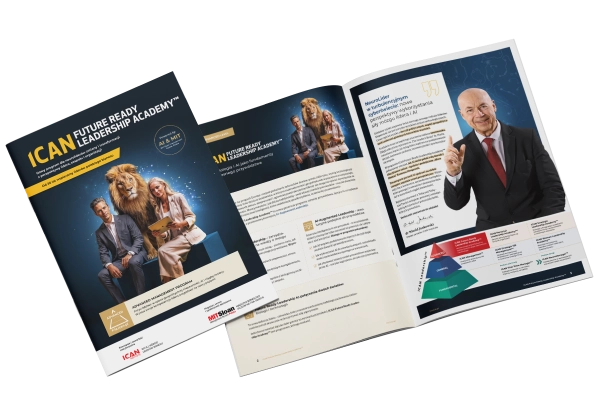
See what's included in the program. Download the full brochure.
Inside, you'll find the training agenda and a complete list of tools. This detailed information will help you discuss the program with your colleagues or supervisors.
- Detailed agenda for all 10 workshop sessions + kick-off
- Complete list of tools, models, and supplementary materials
- Biographies of the presenters and organizational information
Are you ready to lead in the future?
Take the test and identify the key elements of your leadership style in the context of growing uncertainty and the transformation of workplace culture.

Tangible results. Real change in you, your team, and your organization.
You'll understand your brain
How he functions as a leader and how to harness his potential in times of stress and uncertainty.
Better decisions under pressure
You’ll learn how to combine intuition, analysis, and AI support—Dr. Michael Platt’s 5-step decision-making model.
A motivated team
You’ll use biological motivational mechanisms—dopamine, oxytocin, and the goal gradient—to manage your team’s energy.
AI as an ally
You’ll master specific AI tools for your day-to-day leadership role—from the morning briefing to the evening bias review.
Psychological safety
You will build a team culture based on trust and courage—where people speak up, even when it’s difficult.
Architect of transformation
You will learn how to lead complex change using modern models (Kotter 2021, Cynefin, dual operating system).
10 workshop sessions + 3 conference recordings.
The complete leader transformation journey.
The program includes a kick-off session and 10 two-day sessions (Wednesday–Thursday or Friday–Saturday) spread out over the course of the year. Between sessions, participants work on supplementary materials and practical assignments.

A New Model of Leadership in a World of AI, Uncertainty, and Geopolitics

 Witold Jankowski, Ewa Hartman
Scope of content
- Why is a leadership model based on AI and neuroscience a necessity, not just a fad?
- How AI is changing the way we make decisions, build teams, and manage relationships.
- Neuroleadership – training the brain for adaptability, empathy, courage, and precision.
- The Need to Redefine Leadership — Pressure, Complexity, AI, and Neurobiology as the New Landscape for Leaders.
- The ICAN Future Ready Leadership Academy™ program is designed to address these challenges.
Results for the participant
- Understanding the need to integrate AI and neuroscience into leadership.
- An awareness of the impact of AI on decisions, teams, and relationships.
- An understanding of the fundamentals of neuroleadership and how to work with a leader’s brain.
- Recognizing the need to redefine one's leadership.
- Organizing your work in the ICAN Future Ready Leadership Academy™ program.
The Mind of a Future Leader
 Ewa Hartman, Iwo Zmyślony
Scope of content
- A New Paradigm of Leadership – Human + Neuro + AI.
- Neuroleadership as a set of meta-competencies for the leader of the future.
- A leader’s mindset and identity—flexibility, mindfulness, and neuroplasticity.
- How the Brain Responds to Stress and Uncertainty – Building Cognitive Resilience.
- Improvisation and creativity as leadership competencies in practice.
- Creating Meaning and Motivation – Communicating with the Team’s Brain.
Session methodology
- Interactive lectures and discussions based on the research of Platt and Hougaard.
- Exercises in neuro-awareness and self-reflection.
- Improvisation training and decision-making scenarios.
- Analysis of a case study and a leader’s micro-intervention.
Results for the participant
- Understanding how a leader’s brain works and how to harness its potential.
- Building a Future-Ready Mindset based on awareness, adaptability, and intention.
- Applying mindfulness and cognitive flexibility in everyday leadership work.
- Building the ability to inspire a team in times of uncertainty.
Leader of the World of Chaos
 Izabela Stachurska
Scope of content
- The Neurobiology of Uncertainty – How the Brain Responds to Chaos and Change.
- The 4C Model of Mental Resilience – Developing Cognitive Flexibility.
- The Role of AI in Decision-Making and Stress Management.
- Clarity as a leadership skill – building internal anchors.
- Creating Meaningful Space – The IKIGAI Model in Team Practice.
- Community culture – the leader as an emotional and social stabilizer.
Session methodology
- Self-assessment of leadership style in times of uncertainty.
- Decision-making simulations using AI.
- Micro-practices of resilience and reflection.
- An analysis of a case study on leadership during a crisis.
Results for the participant
- Identifying your own approach to handling situations marked by chaos and pressure.
- Learning strategies for building individual and team resilience.
- Supporting the team through clarity, purpose, and presence.
- Enhancing the ability to work with AI as a tool to support reflection and decision-making.
Motivation Neurocodes
 Anna Connor-Łakomy
Scope of content
- The brain's reward system – dopamine, oxytocin, and the goal gradient.
- A Mental Goal-Setting System – How to Set Goals That Motivate You to Take Action
- Motivation 2.0 – Why Traditional Reward Systems Fail.
- Using AI to track engagement and predict drops in motivation.
- The 4-step behavioral activation cycle: trigger – microgoal – emotion – reward.
- How to build a culture of emotional engagement and a sense of purpose at work.
Session methodology
- Map of team members' motivators.
- Setting personal and team goals that boost dopamine.
- Designing a motivation loop using AI.
- Discussions and reflection on one’s own leadership style.
Results for the participant
- Understanding the biological basis of motivation and how to stimulate it.
- Learning to design goal-setting and reward systems based on neuroscience.
- Using AI to personalize support and gather feedback.
- Improving team effectiveness and engagement through intentional leadership.
Decisions for the Future
 Jagna Ambroziak
Scope of content
- The Neurobiology of Decision-Making: The Role of the Prefrontal Cortex, Emotions, and the Limbic System.
- Stress, overload, and multitasking – how they affect decision-making.
- Cognitive biases and heuristics – how to recognize and minimize them.
- Michael Platt's 5-step decision-making model.
- Using AI for predictive and analytical support—without delegating responsibility.
- Decision-making culture – how a leader creates space for reflection and dialogue.
Session methodology
- Self-assessment of the participant's decision-making style.
- Decision-making simulations using AI support.
- Workshop on developing a mindful decision-making process.
- Group discussions on cognitive biases and their impact on the organization.
Results for the participant
- Gaining the tools to make better decisions under pressure and in complex situations.
- The conscious integration of data, emotions, and intuition.
- Applying Platt’s 5-step model in everyday management practice.
- Building a culture of mindful decision-making and reflection within the team.
A Leader's Neurocommunication
 Joanna Burdek
Scope of content
- How the sender’s and receiver’s brains work—synchronization, emotions, trust.
- Cognitive styles and the audience’s neuroprofile – how to tailor your message.
- Techniques for deep listening and a leader’s presence.
- Emotional storytelling – principles, rhythm, the 10% rule (Simon).
- The Language of Influence and Oxytocin-Based Microinterventions.
- AI in sentiment analysis and supporting personalized communication.
Session methodology
- Training in neurocommunication and the identification of cognitive styles.
- Storytelling exercises – "Design Your 10%."
- Negotiation simulations with neurobiological analysis.
- Working with AI: analyzing tone, content, and communication style.
Results for the participant
- Developing the ability to influence others effectively and tailor one's message.
- Building relationships based on presence and trust.
- Creating a memorable message that aligns with the audience’s biology.
- Exploring practical ways to use AI in leadership communication.
Neuroleadership in Practice
 Dominik Skowronski
Scope of content
- New challenges in the workplace: microstress, cognitive chaos, and AI.
- The Fabritius Model: Fun (dopamine), Fear (arousal), Focus (concentration).
- Neurobalancing: rhythms, rest, mental energy.
- Deep work – how to foster it using AI and team structure.
- Physical and cognitive environment – the influence of microfactors (light, sound, rhythm).
- Empathy and presence as skills that cannot be replaced by technology.
Session methodology
- An audit of the neuroenvironment of one's own team.
- Exercises in deep work and managing micro-stressors.
- Designing a team's work rhythm (Brain Rhythm Canvas).
- Practical applications of AI: blockers, planners, cognitive analytics.
Results for the participant
- The ability to design a brain-friendly work environment for leaders and teams.
- Understanding the principles of neurobalance and applying them to your weekly routine.
- Using AI without overloading the cognitive system.
- Strengthening the leader’s role as the architect of rhythm, meaning, and focus.
The Power of Diversity

 Piotr Stohnij, Patrycja Olchowska
Scope of content
- Diversity as a source of cognitive resilience and innovation.
- The Neurobiology of Inclusivity: How the Brain Responds to Difference.
- Conscious inclusive behavior – micro-interventions and inclusive language.
- Neurodiversity – what it is, how to recognize it, and how to support it.
- Managing Diverse Teams – Rhythms, Redundancies, and Interaction Rules.
- A leader as a mediator of differences and a builder of bridges of understanding.
Session methodology
- Self-assessment of inclusivity and micro-messages.
- Scenarios and simulations for working with a neurodiverse team.
- Designing a cognitively safe environment.
- Case studies of companies that leverage diversity as a competitive advantage (e.g., SAP).
Results for the participant
- Acquiring the skills to effectively manage diversity and inclusion.
- Learning how to work with people who have different neuroprofiles.
- Building a team based on mutual trust, regardless of differences.
- Strengthening the role of an empathetic and inclusive leader.
Transformation Architect
 Hubert Malinowski
Scope of content
- The new environment of change – from design to continuous adaptation.
- Kotter's dual operating system model – hierarchy + network of activists.
- The Cynefin Model – How to Identify the Type of Change and Choose the Appropriate Course of Action.
- The role of a leader in unleashing the energy of change, not just managing it.
- AI as a tool for analysis, personalization, and predicting changes.
- Map of the 5 Questions for Change Leaders + Tools for Dealing with Resistance.
Session methodology
- Analysis of the type of change and the decision-making domain (Cynefin).
- Designing a change map using AI.
- Simulation of working with resistance and change communication.
- Teamwork: What You Can Change About Yourself, Your Team, and Your Organization.
Results for the participant
- Understanding how to lead complex change using modern models.
- Learning about tools for building grassroots momentum and a framework for change.
- Using AI as a tool for change, not a threat.
- Strengthening the leader’s identity as an architect of transformation, rather than merely an executor of decisions.
Leader + AI = Innovation
Iwo ZmyślonyScope of content
- The Creative Brain: How the Default Mode Network, Salience Network, and Executive Network Work
- The expert paradox and the “average team” effect—what kills creativity.
- The 1–2–3 System: intuition, reflection, and AI as a cognitive enhancer.
- Principles of hypothesis design – “what if…” thinking, testing, and scaling.
- The creative cycle: exploration → validation → incubation → testing.
- How AI supports creativity: suggestions, unexpected connections, and iterating on ideas.
Session methodology
- Exercises in hypothesis-building and insight generation.
- Brainwriting + AI as the third element of the idea.
- Simulations of teamwork.
- Case studies of innovative teams and AI applications in value creation.
Results for the participant
- Developing creative thinking and action despite the system's limitations.
- Learning strategies for designing experiments and formulating hypotheses.
- The ability to use AI as a creative partner.
- The ability to design an environment that supports continuous exploration and iteration.
Neuroleader in Practice — Summary and Plans
 Wojciech Mendyka
Scope of content
- Program Retrospective – Identifying Key Ideas and Tools.
- Neuroleader Competency Map – Integration of Models and Micro-Practices.
- Team simulation – applying all competencies in complex situations.
- Plan JA – TEAM – ORGANIZATION – priorities, obstacles, levers.
- Creating a personal transformation manifesto.
- The Activation Cycle – Commitments, a Letter to Yourself, an Implementation Plan.
Session methodology
- Reflection and summary exercises (one-on-one, group).
- Full simulation – a leader in complex contexts.
- Workshop: The 30–60–90 Day Plan.
- Closing Ritual – Circle of Influence and a Letter to Yourself.
Results for the participant
- Integrating the knowledge and skills from the entire program into a cohesive operational model.
- Creating a personal development and implementation plan.
- Strengthening the identity of a leader who learns and transforms the environment.
- Participation in the Neuroleaders network, where members support one another in their work.
Practitioners and experts — front-line experience.
Our experts have gained their experience by working with Polish and international companies. They have a deep understanding of the challenges and struggles managers face.
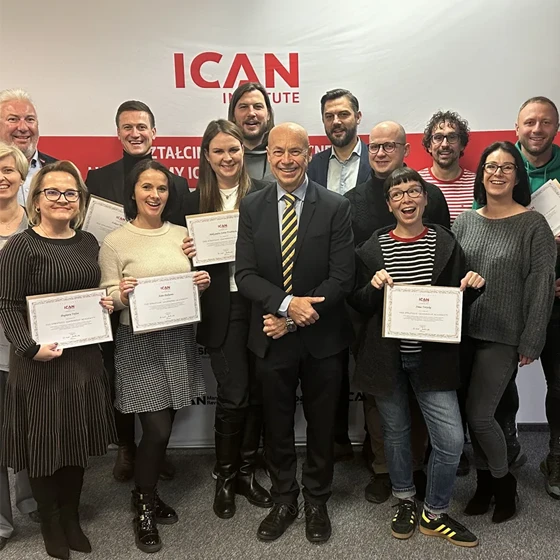
Graduates of the ICAN Future Ready Leadership Academy™ — the neuroleaders of the future.




The skills acquired are certified by the ICAN Institute
Every participant in the ICAN Future Ready Leadership Academy™ program will receive a prestigious certificate. This credential is highly valued in the job market and sought after in both recruitment processes and internal succession planning.
About 80% of graduates post their certificates on their social media profiles—particularly on LinkedIn.

Quality Guarantee: No Risk and Money-Back Guarantee
We know that investing in a comprehensive, year-round program can be daunting. That’s why we’re the only ones in Poland to offer you a unique quality guarantee:
If, after two sessions (four training days), you decide that the program does not meet your expectations, you may withdraw from the program and receive a full refund.
Yes, we’ll give you a 100% refund. There’s no risk involved in participating in the training—just opportunities for growth and tangible results.

Sign up for the program.
- 10 sessions + kick-off
- 3 conference recordings (Platt, Hugander, Simon)
- ICAN Leadership Digital Learning Center
- MIT Sloan Management Review Poland
- myICAN Assistant
- ICAN Institute Certificate